Plastiras lake in early spring

Plastiras lake in early spring

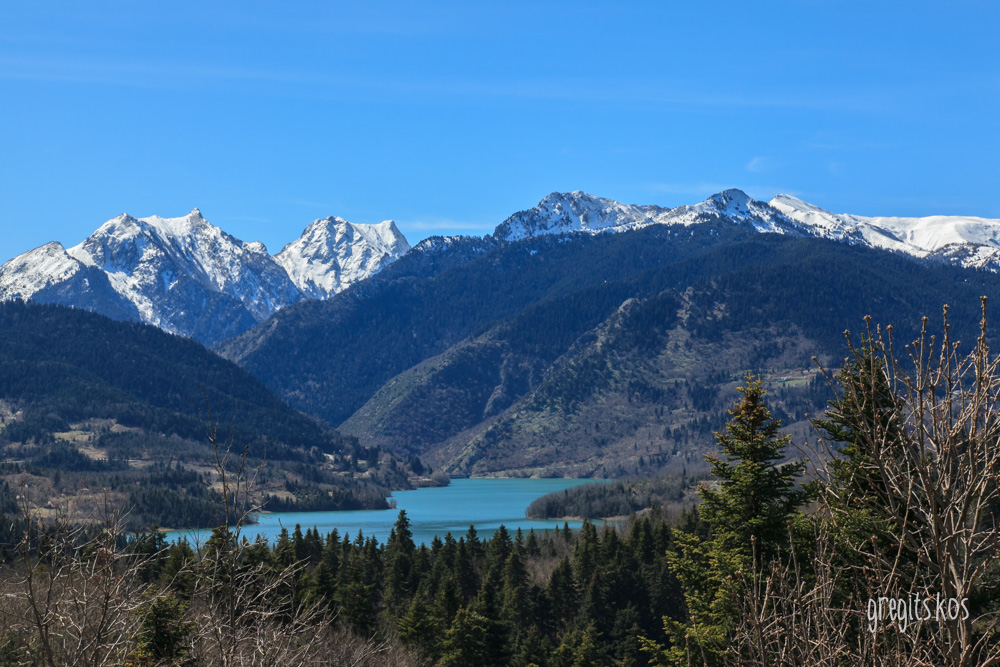
Just nature and you! This is the sense you get from the first moment you face the lake. It activates all your senses. You can hear the silence interrupted by tweeting birds or the sound of wind passing through the foliage of the trees, smell the smoke from the fireplaces while your eyes follow the turquoise waters of the lake forming small fjords.

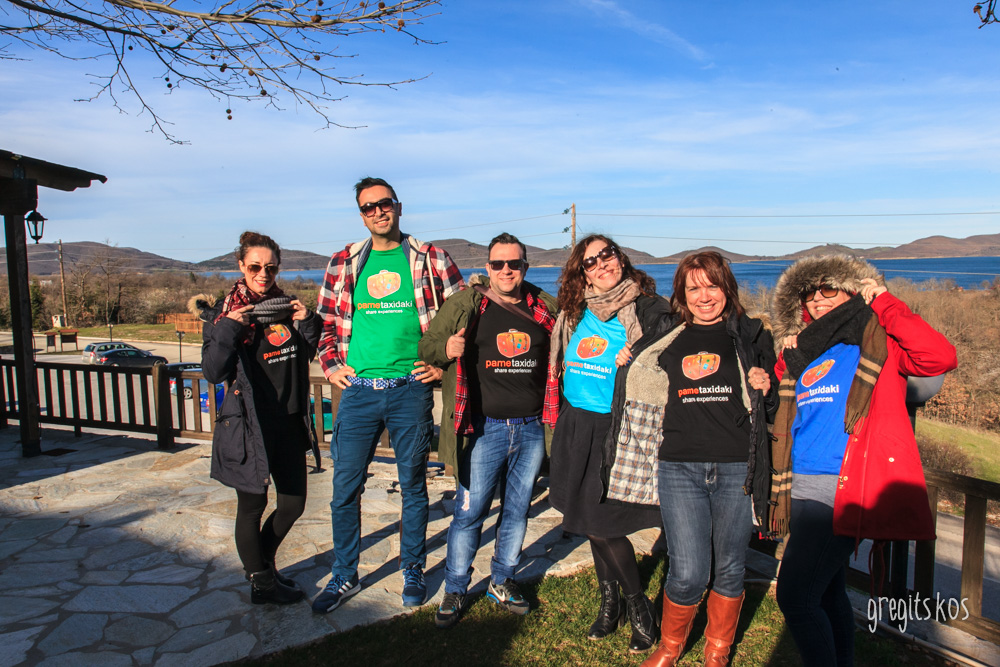
The lake view from the East Our 2 days’ trip to the region was more than enjoyable. We set off on Saturday morning with direction Larissa – Karditsa. After Karditsa we followed the south direction so we turned left towards Agios Athanasios – Lambero.

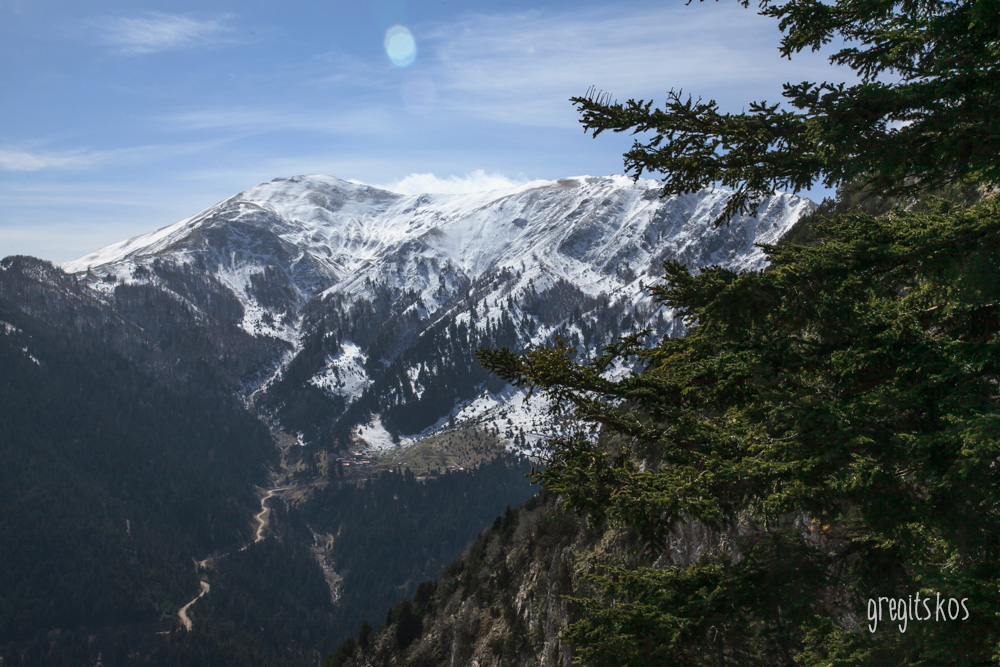
The view of the lake from this side is unique! Swiss landscape with snowy peaks above the lake! Each turn reveals a new setting. After a small adventure that led us to the center of Lampero we arrived at the Dam.Megdova Dam The 220 meters long Megdova Dam, completed in 1959, holds the waters of the flood Tavropos, former plateau of Nevropolis, forming Lake Plastira or otherwise Tavropos. On this side there are small shops with local products (ouzo, liqueurs, honey, noodles, herbs ...). We walked along the arc that forms the dam, gazing at the lake from one side and on the other the precipice of 83m. and when the traffic light turned green we passed on the opposite side.

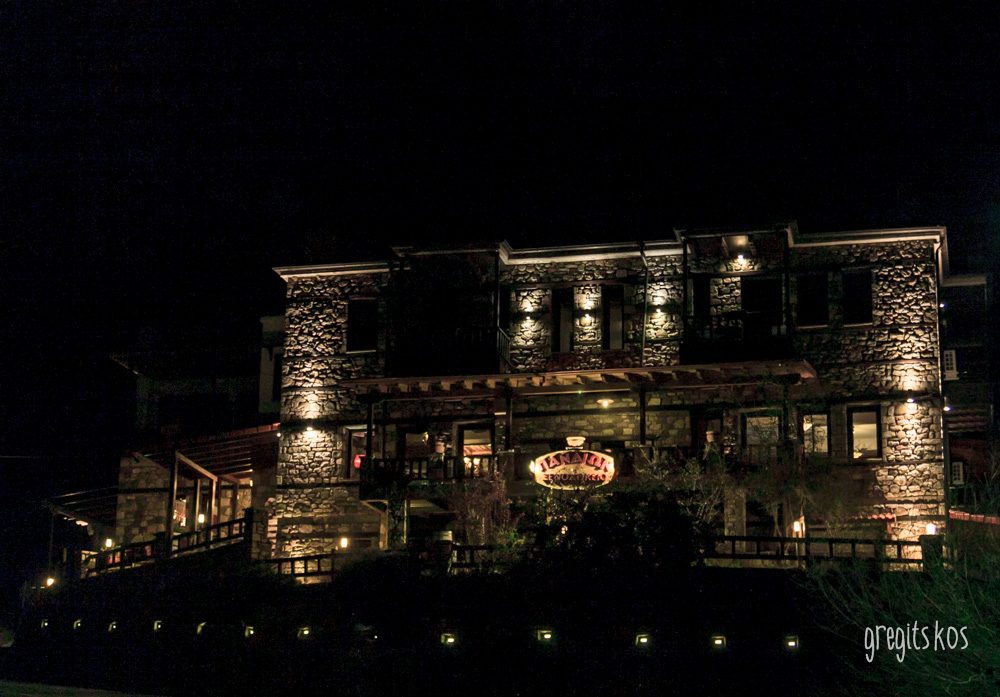
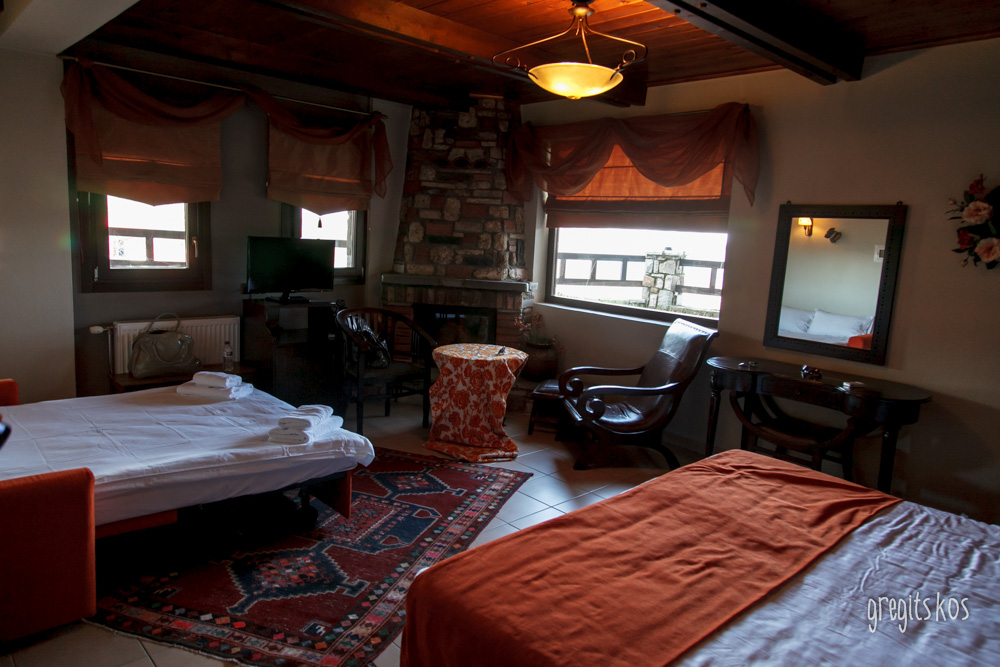
Continuing our way northwise now, we crossed Belokomiti village to arrive later at Neochori where hotel "Pandion" hosted us on Saturday night. Neochori -the most touristic village in the area- spreads on the slopes and offers panoramic views of Lake Plastira. The two junior suites of "Pandion" suited us fine. The people of the hotel with their warm hospitality made us feel at home!

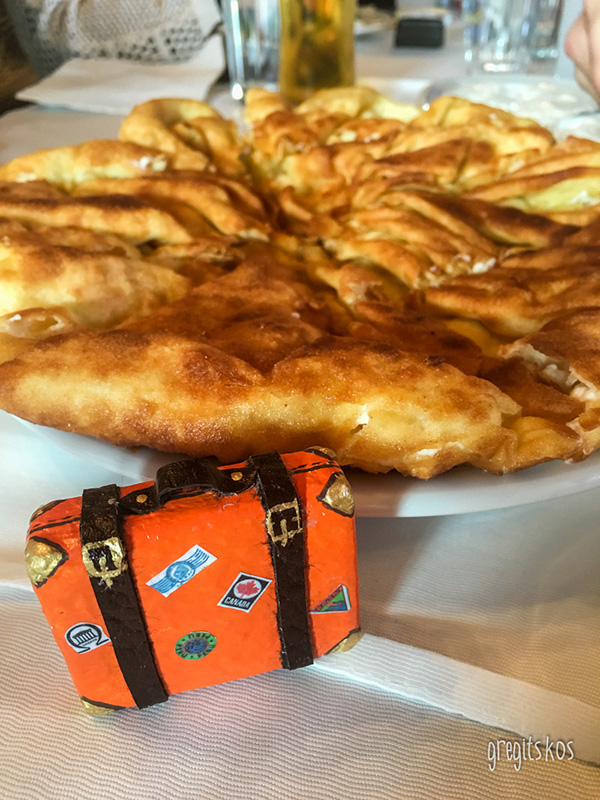
Our hunger led us to Tavern "Mushroom" just outside the village, in a beautiful location overlooking the lake. Preference of many visitors from what we saw, it left us happy with the dishes we chose. Mushroom soup, prasotigania (fried pork with leek), burgers and chicken ala crème. The very nice “tsalafouti” dish (local cream cheese) and less “Cleomenes potato”. (90 euros / 7 persons).


hotel "Pandion" «Tavropos» activity centre

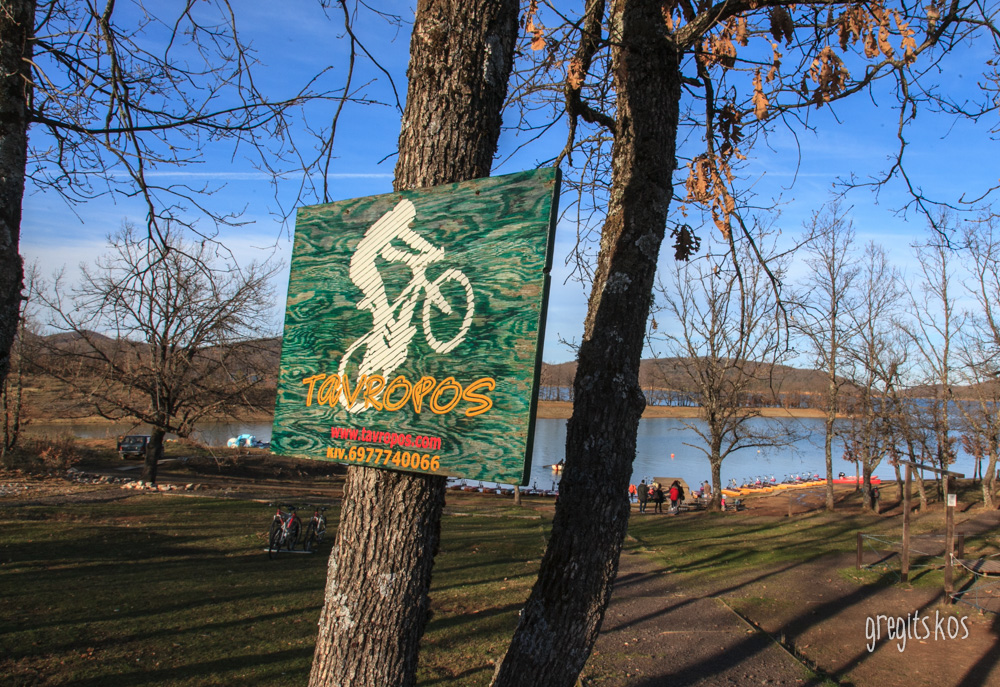
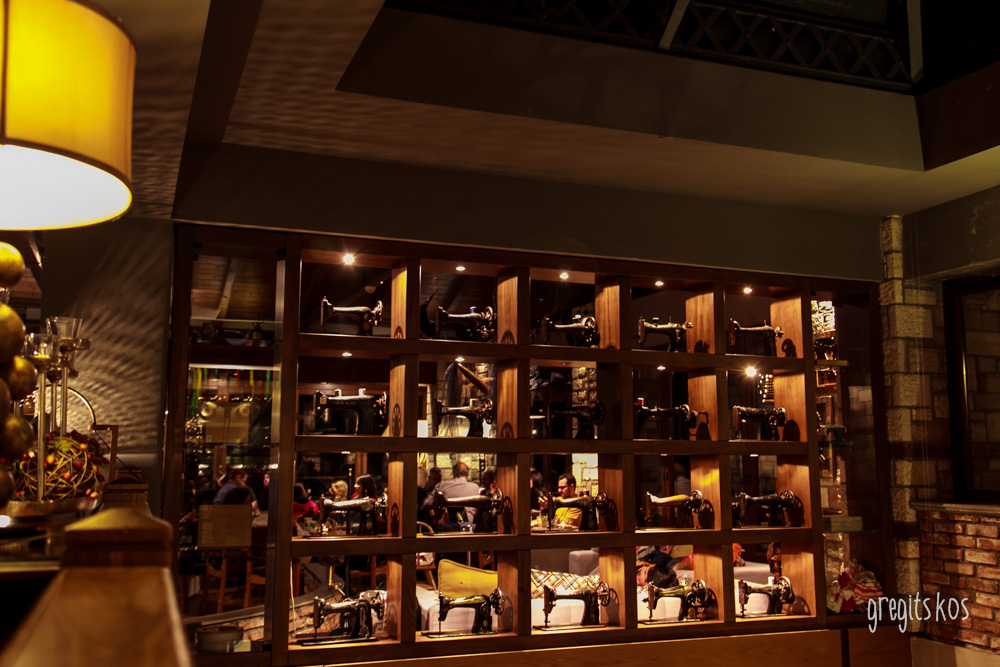
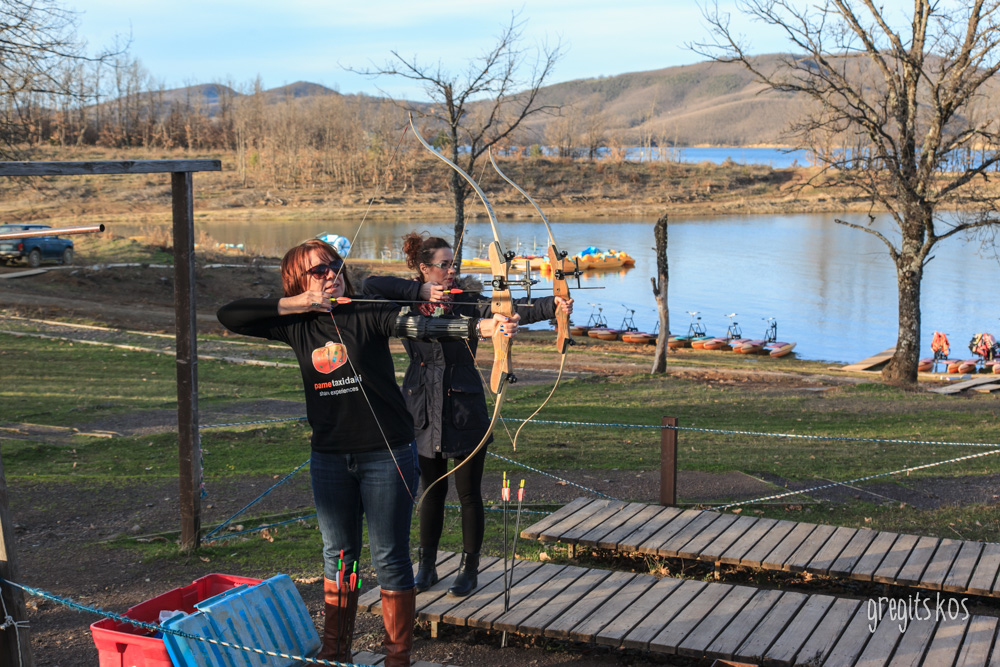
The sun was still warming us when we were heading to Kalyvia Pezoula lakeside. We were looking for a coffee spot but we ended up at a center of outdoor activities, a few meters before the beach. «Tavropos» activity centre offers bike rides in the lake or outside, archery, canoeing, etc. Half the group went water cycling, the rest tried archery. Until it got dark...... Coffee was waiting for us in Kazarma hotel. So was the chocolate soufflé! What is there to say about Kazarma? You have to see for yourself! (In Kalyvia Pezoula heading north, a sign leads left on the slope)

SUNDAY

the monastery of Panagia Pelekiti Breakfast in “Pandion”, a full buffet covering all preferences a nd planning the rest of the day. Our first stop was the monastery of Panagia Pelekiti (open hours: 10.30 to 4.00 ") carved in a vertical rock with two temples, Ascension and Virgin Mary (1640), overlooking the lake from above. There we shot some of the most beautiful panoramas. The impressive stone-built church was recently restored and its unique frescoes of the 15th century were preserved, as we were informed in a thorough tour that was offered to us. Tavern FloresiWe skipped the visit to the Observatory and the Botanical Garden for the next visit and we got uphill towards Anthochori. In order to see if the information they had given us was valid.

Waterfall of Anthohori”: 1200m. distance, was written on the sign just berore the village entrance. Not so far some of us thought! The uphill path took us 50'to walk it to and fro and it was worth every minute of it.

We were more than ready for lunch when we got back! Tavern Floresi for uniquely home cooked food! In the center of Anthohori! There are simply no words to describe it! Rooster with noodles, beef in a pot, and galotyri (type of local cream cheese), all unique! Ms. Helen is an artist in cooking! Everything cooked with local ingredients, handmade by her. Excellent service as well! (EUR 70/7 person) And when it was time to leave we thought that we had such a beautiful time, worthy of sharing our experiences in that place with you!

For more information about the area visit the site: http://www.limniplastira.gr/en/

panoramic view of the lake

Pelion, where the mountain meets the sea

Pelion, where the mountain meets the sea

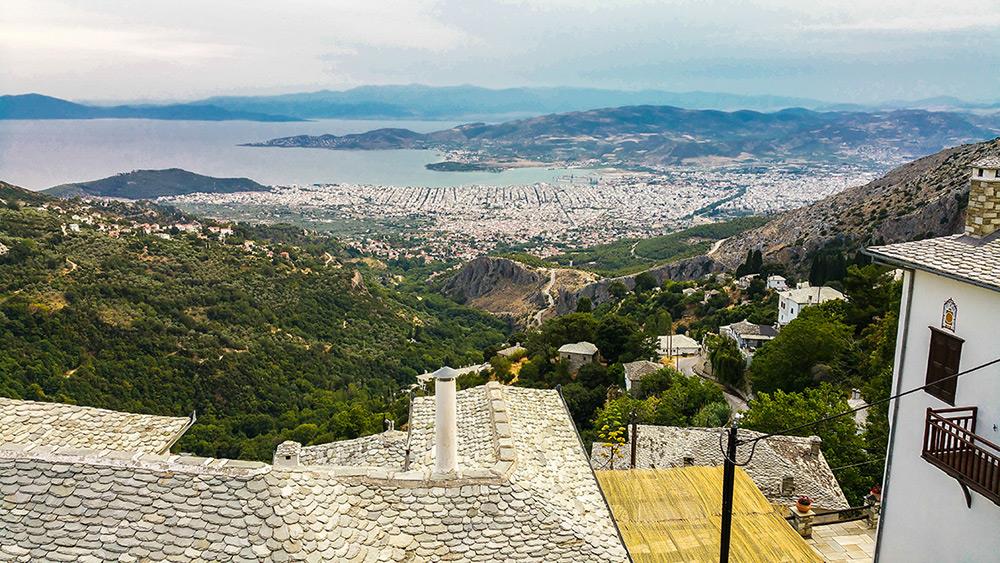
The decision to spend our summer holidays in Pelion was not difficult, since it combines the sea and mountains and can satisfy the lovers of both. That’s why we picked it as our destination. Everything was ready for our five-day getaway in the mountains. The hero of the story is the little “smart” which travelled from Athens to Pelion without protest. Our destination was the village of Milies, a mountain village in South Pelion and specifically the traditional lodging “Anemoessa”. The truth is that we encountered traffic on the ring road of Volos, from “Achillopouleio” hospital until the traffic lights of the ring road. We thought that it was Friday afternoon and the local people wanted to escape the city!!!!

The landscape begins to change after “Agria”, where you can start to relax and enjoy the green of nature, generously spread around you. The road signs were very helpful, so we easily found “Anemoessa”. There we were welcomed by Vangelis and Helen, the owners, with a smile and a cup of coffee. The coffee was followed by “raki” since you can hardly resist the beneficial breezes and wonderful views. However, “raki” without “meze” is not a usual thing, so Helen baked a pizza to complete the menu!
Pelion, the mountain of the mythical Centaurs Planning for the next day, we decided to enjoy the blue moon (which no one could say it was blue in any way!!!!!) from the balcony of Anemoessa. To our surprise, breakfast was served from 08.30 in the morning until … whenever it was convenient for us!!! First time we met this in a hotel. And we really loved it!!! No alarm clocks for breakfast on vacation!!!! Let us talk adout breakfast now! … .fresh country eggs, Pelion honey, croissants, rolls, cake and Helen’s homemade pie. Cereals, jam, coffee, juice, milk. We were so lucky with the desert!!! Creme caramel!!!! Having breakfast overlooking the mountains and the sea! We wouldn’t change it for anything!!!
After such a pampering, we started our tour making the first stop at “Afissos beach”. It took us half an hour to arrive at the beach which was well organized. Caution at the intersection of Afissos as the sign is … a bit shabby!!! To access the beach you have to go down stairs which, however are easy to descent. It was Saturday and it was really crowded and hot. There were no sun beds available but a girl served us giving us an umbrella (quite small) with two sun beds. We paid 7 Euros for two coffees, an umbrella and two sun beds. As time passed the heat was increasing and so was the crowd! The decision was made immediately to … .set off in search of a cooler place!!! We headed to “Milies”, to the old train station. A place full of trees with unlimited freshness and tranquility!!! The cicadas were literally giving concerts!!! We couldn’t ask for anything more beautiful … .unbelievable views with coolness and cicadas singing!!! It was something we couldn’t easily forsake, so we sat in the restaurant “Old Station”. We tasted a very tasty “vlita (amaranth)” salad and a hearty village salad. We ate well and mainly in the dew!! In the evening we strolled around “Milies”. Those of you, who will choose not to use the car and walk around the village through the cobbled streets, take a flashlight with you at night because the streets are poorly lighted. In the village square, there are trees, taverns and man springs. Two shops are ideal for a relaxing drink, the “Rose and Nightingale” and “Anna, here is an apple.” The truth is that we chose the first because it had tables on the terrace offering a view! It was a good choice … .the perfect view … the moon still perched in the sky and the classic beneficial breeze … .What more could you ask in your holidays? The service was very good!
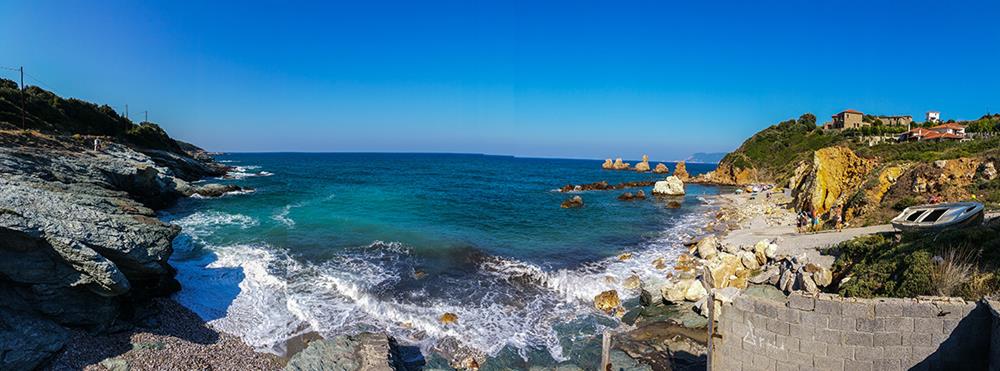
Mortias bay The next morning we awoke with the sound of the rain falling!! What a nice switch!!! Not a day wasted even when it rains! We decided to visit the mountain. We set off from “Milies” heading to “Vizitsa”, about one quarter of a hour drive. A “green” route, as well!!! Through trees!!! And at the roadside water flowing! A stop in Vyzitsa for coffee and a stroll around the traditional ,quite village. Few people around! The ascent was leading us to “Hania”. A winding, difficult road, but the scenery around compensates you. Lunch in the “Lucullus” where the view, once more was imposing! They serve “Kontosouvli”(pretty good), pasta and “vlita” salad. After enjoying a cup of coffee we set off to our hotel, taking a different route this time, through “Tsagarada”. The road through Tsagarada was in better condition. It was around sunset at that hour and we stopped to enjoy it. In the evening, we relaxed with a glass of cold beer, chatting in Anemoessa with the best company !!! Helen and Vangelis !!!! The next day started with a visit to “Mourtias” beach which can be reached through the road that leads to “Argalasti”. In fact, it is a creek overlooking the Aegean Sea and Skiathos island. The sea was nice, with an impressive landscape of surrounding rocks as well. A quick dip and a visit to the village of Platanias where we preferred to drink our coffee overlooking the sea. Back at our base , a walk and a drink in Milies. And an important decision we had to make… to extend our holiday for another day. How would it be possible to leave this place?
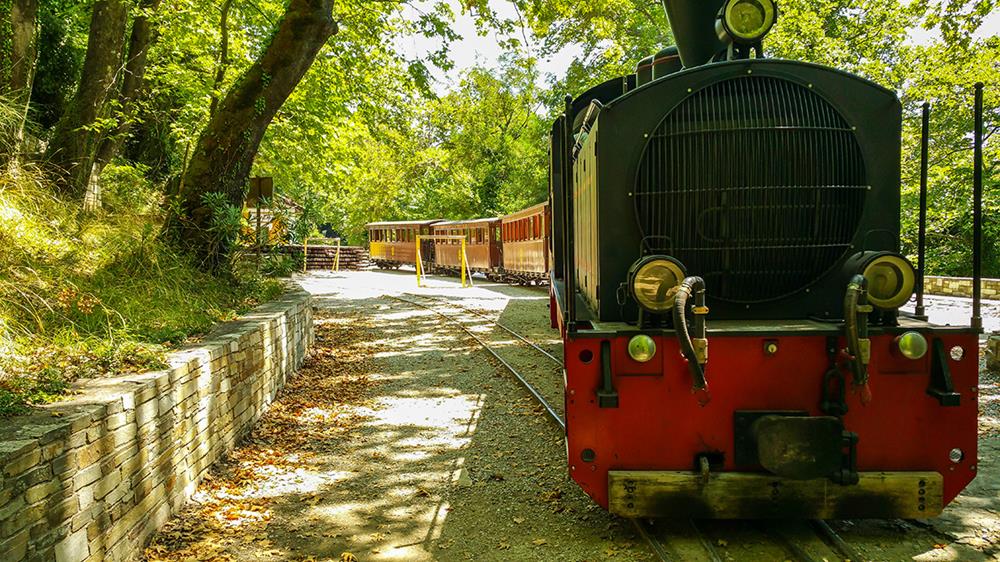
Sleeping until late the next morning, we decided to take “Jason”, the train, to “Ano Lechonia”. So, without wasting valuable time and after getting the tickets, we run to take our cameras and everything else necessary for a trip back in time … when “Jason” was the only means of transport connecting Volos with the South part of Pelion . “Smudgy”, as they call it, named after the ash spread in the passage of the steam engine, which was gasping up and down through the lacy mountain route it started its journey… without locomotive. With a petrol engine that has a similar construction to the old steam locomotive, but without the fumes of the burning coal. It starts its route through the trees of “Milies” and goes downhill with new a version of gasping.
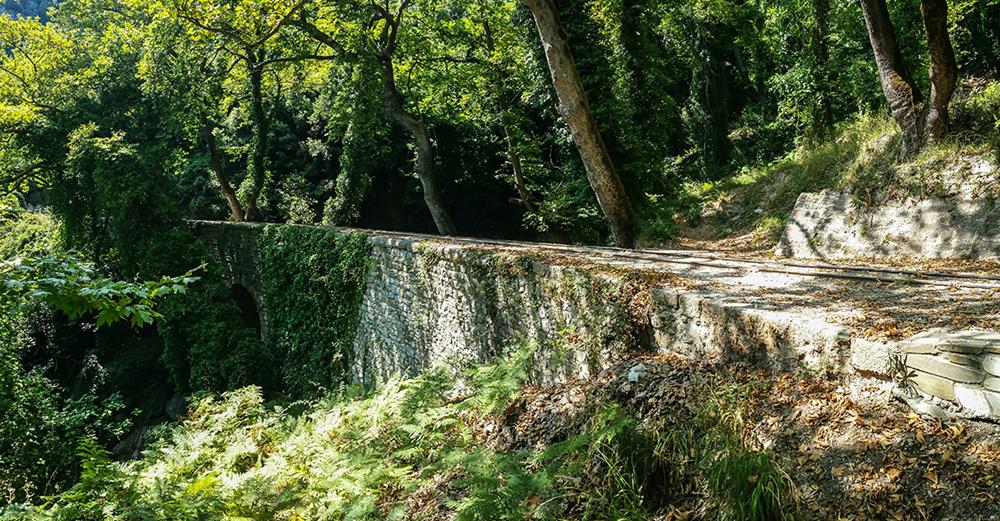
Going up and down the Pelion slopes Going up and down the Pelion slopes, you are transferred to another era, back at those times of wooden wagons. The logo of Thessaly railways is printed everywhere; it’s the company that exploited “Thessaly Railways” for many many years back. The balconies in the wagons, just like the seats bring into life smells from another era … the sounds and images of Westerns, as if you expect an instant attack by Indians. The train passes by old stations connecting Volos with the villages of Pelion. “Pinakates” ,”Ano Gatzea”, and the kids being ecstatic every time “Jason” passed through a gallery or an arched bridge. Jumping from one side of the wagon to another to catch some of the view And as soon as you have got used to the images and the humming of lines and wheels, the squeaks of the wooden wagon, you feel the speed of buck-passing declining, as it approaches a residential area and the sign at the station no longer writes Upper Lechonia. But the train does not just stop. It goes down until you see the diesel train changing direction and preparing to go to rest in a special covered area of OSE until the next day.
And if you believe it is easy to travel by “Jason” and you choose to do so … then we’ll help with the following tips:
1. Schedules: whenever- so ask before you set off (information at OSE offices)
2. Itinerary from “Ano Lechonia” to “Milies” at 10.00 am. The trip lasts for about 1- 1.5 hours. Then you have to stay in Milies for about 3 hours and at 15.00 return to “Ano Lechonia”.
3. 10 euros for a one way ticket
4. Plan the trip carefully because the itinerary is one per day and it’s the only one reciprocating “Ano Lechonia” – “Mileai” – “Ano Lechonia”.
5. For railway enthusiasts: don’t forget your camera.

I"Jason"n the same afternoon we decided to pay a visit to Makrinitsa. The road was as usual in Pelion … full of turns!!! Makrinitsa is probably the most touristic village we visited but you without, of course losing its charm and unlimited green. In the central square, there is a shop with products from the Agricultural Co-op of women in Pelion (sweets, pasta). In the evening we returned to Milies for a glass of cold beer at the balcony of Anemoessa.
The last day of our stay was spent in Milies. The last evening ended with dinner at “Panorama” restaurant and plenty of raki in Anemoessa of course!!!! Next morning we enjoyed having our breakfast, we packed our stuff and said goodbye to Vangelis, Helen and of course the Duke!!!! Along with the promise to come back some day!!!!

A 2-days’ trip to West Zagori

A 2-days’ trip to West Zagori

Easter was very early this year. We always have a small trip somewhere in the 2nd week of Easter holidays but this time we were a bit concerned about the weather. It was rainy and cold. The excursion was arranged the minute we saw the photos of a hotel that Vasia (our niece) booked for a weekend. The hotel was in Papigo and she had traced and booked it from Belgium! It has been almost twenty years since we last visited the area. We were so jealous! Both about the hotel and the destination.

We arranged everything right away! An evening at the “Astra Inn Hotel” (unfortunately there was no vacancy for a second), in Papigo and one in “Gamilla Rocks Mountain Hotel” in Aristi, the village just next to Papigo. Early on Easter Tuesday morning, we set off from Veria to Zagorochoria. In less than two hours we were leaving Ioannina and taking the road up to Zagorochoria to the north. After 35 km we passed by the historic Kalpaki (at the entrance of which there is a nice war museum). Another 4 km and a sign showed us the road that goes right ways , towrds Aristi (10 km) and Papigo (23 km)the magnificent view from the rock of the belfry (Panagia Spiliotissa)
Tip: The last Gas Station is in Kalpaki. Fill in there!

So we turned right and began slowly to ascend the road. After 4 km we passed through Mesovouni village and another 4 km near the village of Agios Minas. 2 km further we reached beautiful Aristi. We crossed it took the road to Papigo.

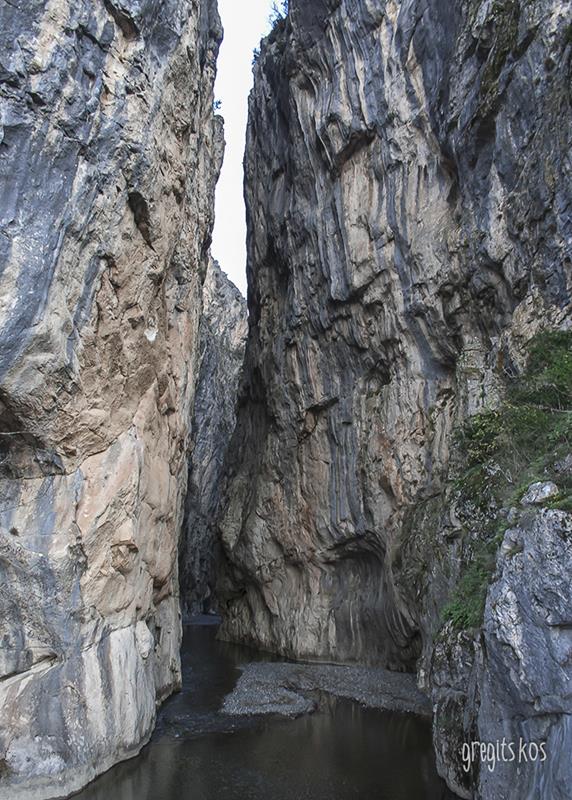
3 km after Aristi, we came to a sign that leads the way to the path to Panagia Spiliotissa. (There is a small opening of the road for parking). A newly built bridge and a 5 minute walk leads to the monastery, built in 1579 in a fantastic location, right over the river. "It has an impressive carved iconostasis and frescoes from the 17th century. It served as a refuge for the inhabitants when in danger. After the earthquake of 1897, it was completely abandoned. It has now been restored and is quite tidy but the church cannot be visited”, we read on a guide book. It was abandoned for sure, and it’s only worth going up there just for the walk through the towering plane trees, but especially for the magnificent view from the rock of the belfry, if you are eager to climb up there.

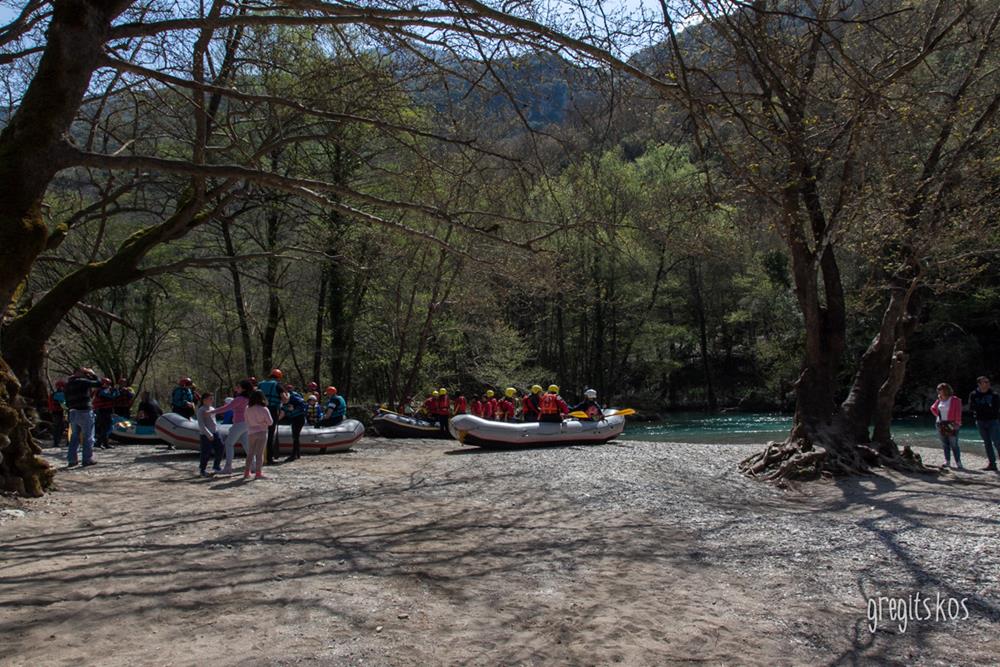
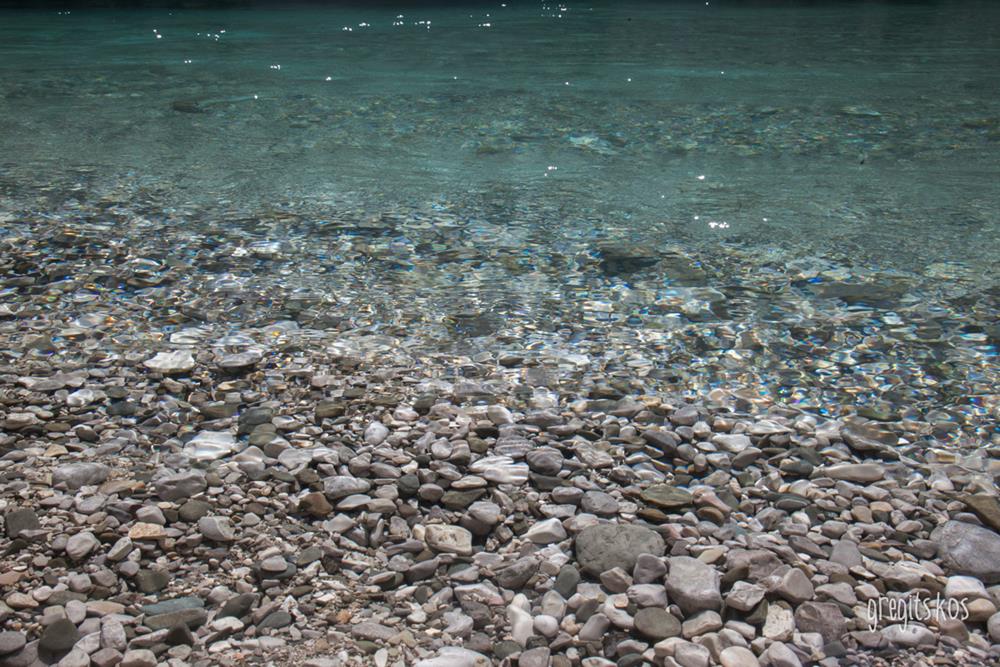
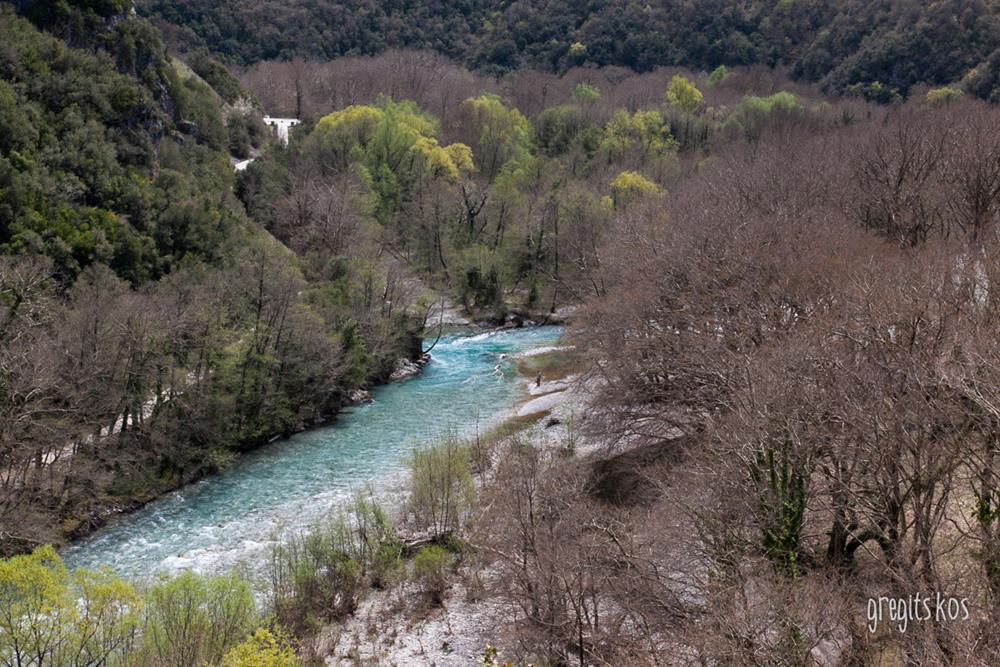
Papigo bridge     We returned to the car, and after another 400 m we suddenly saw the bridge and the river! (Caution! The narrow bridge does not fit two cars to cross at the same time. Moreover, being particularly pointed, the driver standing at one end of the bridge, has eye contact only with half of the bridge!) Once we went across, we parked on the right, in a plateau under the trees. The water that poured this year had changed the configuration of the landscape. It was very different the last time we visited it. What had not changed at all were the crystal clear, emerald waters of Voidomatis River. That’s why there were dozens of visitors, admiring the scenery, taking photographs and many of them preparing to descend the river by rafting. Inflatable boats, life jackets, trainers...... (The ride until Klidonia costs 25 Euros per person)

(The path leading to the river head starts at this point. Through the dense plane trees and a direction opposite to the flow of the river, with a relaxed pace, in about three hours, one can reach the riverhead of Voidomatis). Voidomatis is one of the cleanest and coldest rivers of Europe, since its waters, even in the heart of summer, during a heat wave period, do not exceed a temperature of 6 ° - 7 ° C. Etymologically, the term Voidomatis probable derives from the Slavic "Voda Mate" meaning “spring/fountain”.

Back in the car, we began climbing up the twisting, winding road to Papigo: within a distance of 3 km from the river, we passed at least 17 - 18 “hairpin bends” of 180 °, ie the notorious "Kagelia of Papigo", where increased attention is needed, especially when the road surface is slippery and even on the way downhill.

We arrived to Papigo! On the left, there is a spacious free parking (for those who want to leave their vehicle and continue on foot (unless you have to unload suitcases, etc.). In front of us we saw the first church, completed in 1852 and dedicated to Saint Vlasios . Just beside it, is the imposing hexagonal stone steeple of 1887. A few meters after the church we passed by "Kallineio School" that was built in 1897 and houses the nursery/ primary school.Towers of Astraka

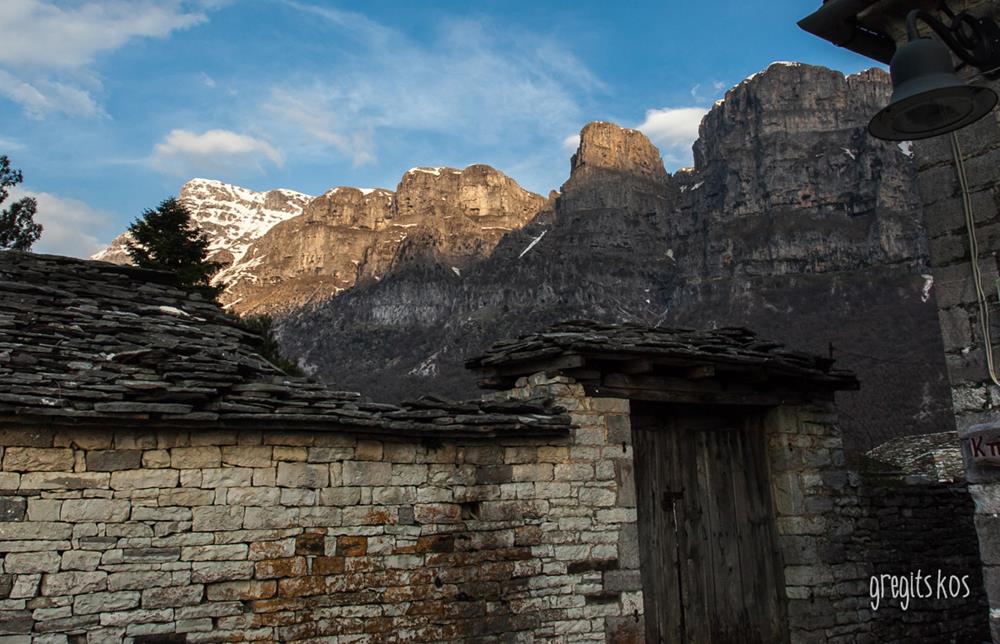
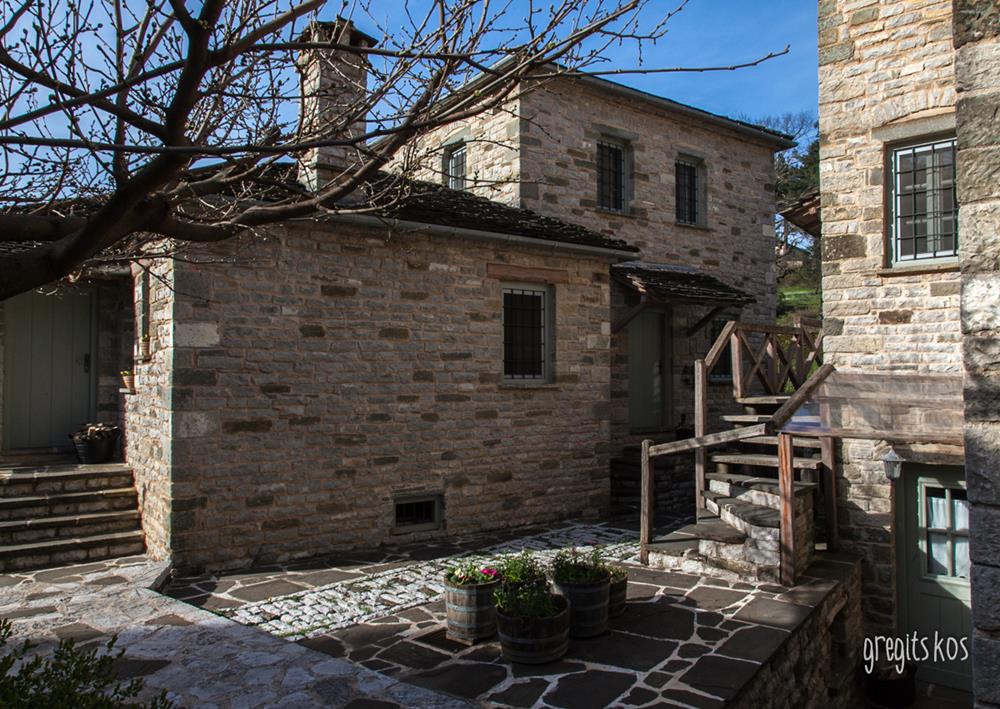
Papigo is built at an altitude of 980 m. In fact, there are two villages or if you prefer a village in two neighborhoods. Some refer to them as Megalo Papigo (Big Papigo) and Mikro Papigo (Small Papigo) (1,040 m) which is 3 km further. They are definitely the most beautiful villages of Zagoria, perhaps the most touristic and it should de noted that they are protected traditional settlements. The population in Papigo decreased significantly during the 40s, 50s and 60s and reached its lowest point in 1971 with only 95 inhabitants. Currently, there are about 250 inhabitants (in both villages). All the glorious art of Zagoria’s craftsmen to reclaim the only product that nature gave them abundantly, the stone, unfolds in this corner of the country. Beautiful traditional houses with stone roofs, well kept paths, beautiful stone fountains, all made of stone. And all this with the background of the "Towers of Astraka," a series of five, huge rock formations of Mount Gamila (or Tymfi), rising just above the houses, a real eye catcher. Our hotel was the last building of the village, on the road to Mikro Papigo. Facing the towers! Stone terraces, corners with flowers, tables in the sun! We looked further up to the mountain. Small Papigo was standing, perched on Tymfi’s slopes. Half an hour later, we were drinking our coffee on the terrace of the hotel "Mikro Papigo", at the highest point of the village and a little later we were tasting Zagori pie, smoked sausage and grilled mushrooms in the Astra Inn restaurant. In the courtyard, under the pleasant sunshine!The view from the "1800" hotel terrace
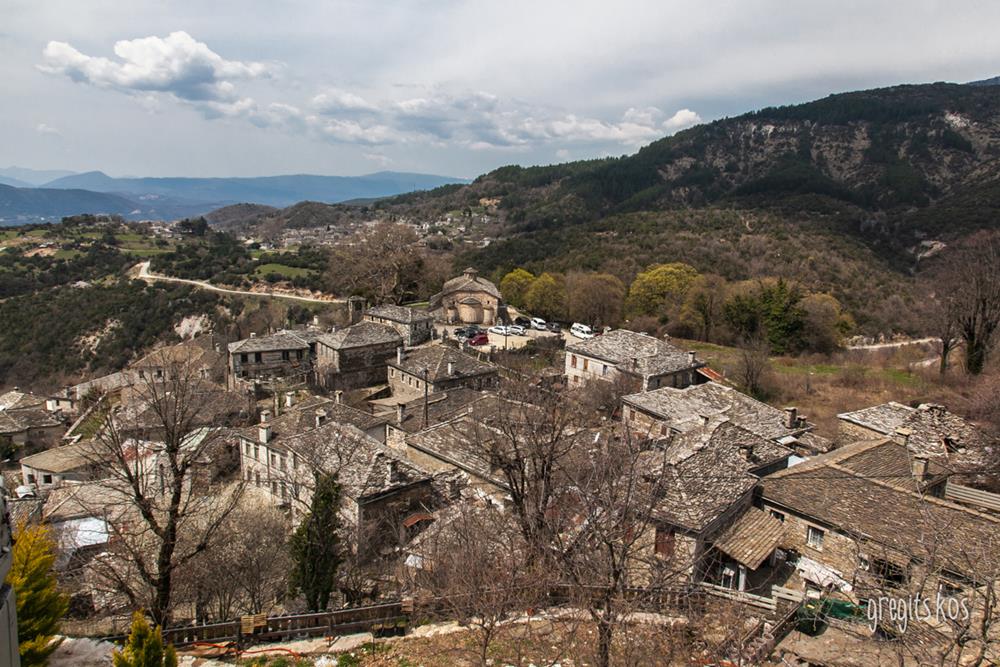
In the evening, the village retained its beauty, with yellow lights faintly illuminating the streets and the silence that reflected our steps in the cobbled paths, to make it even more atmospheric. We enjoyed our coffee in the courtyard of an old café (“Koulis”), at the small square, and later a drink by the fireplace.

Astra Inn    The wonderful breakfast in the next morning, raised the trip to the top of the evaluation scale. Delicious, homemade breakfast, in a wonderful room, coffee in the courtyard, under the trees, chatting with the people of Astra ... reluctantly we got up for our morning walk. Halfway on the road to Mikro Papigo (3 km.), on our right, we went down a path that lead to a ravine with a beautiful stone bridge. On the same stream, just a little further, on the left of the road this time, we saw an all green ravine. It is the stream of Rogovo, forming large natural pools, which the locals call “ovires” or “fonts”. Here, during the warm, summer months, a lot of people take their swim.

Going further up, we arrived to Mikro Papigo. Cars, fortunately, cannot enter through the narrow cobbled streets. Everybody park next to the church of the Archangels, with the perennial plane tree. We walked down the alley and at 40 m on the left we stopped at the "Information Center for Nature and Culture at Zagori", which was founded by the WWF and is hosted in the building of the old primary school, a donation of Michael Anagnostopoulos.

   VISITING HOURS: Daily /Weekends (except Mondays) 9.30- 15.00 (tel. 2653025096). Very informative material for the region from the Management Body of National Parks “Vikos –Aoos”. There, they informed us on the many mountain trails that offer courses of various difficulty levels. A popular trail includes the crossing of the Vikos Gorge. (six-seven hours’ hiking/medium difficulty)

HIKING TRAILS

Mikro Papigo - Drakolimni: 3 hours (one way) Monodendri - Mikro Papigo: 7 hours (crossing of Vikos gorge) hiking trails info
Mikro Papigo - Gamila: 5 hours (one way) Kapesovo - Vradeto: 1.30 h (round trip)
Mikro Papigko- Red stone 40 '(one way) Klidonia Bridge - Bridge Papigo: 2.30 hours
Ano or Old Klidonia - Papigo: 2 hours Vikos -Voidomatis headriver: 1. 30hours (round trip).

WE SUGGEST : On a longer stay

Mikro Papigo, at an altitude of 1,700 m, is the basis for many climbers starting climbing to either the legendary Drakolimni or to the famous caves of Astraka or the peek (2.497 m.). The well marked trail starts at the last houses of the village, after an hour’s walk it comes out of the woods, climbs on bare landscape, passes four fountains at different altitudes and leads to the mountain lodge at 1,940 m. (Tel. 6973223100). From that spot, it descends until a point called “Xeroloutsa of Tsoumani” and finally climbs (in total 4-5 hours’ walk from Mikro Papigo) up to the 2,050 m. plateau, reaching the famous Drakolimni (dragon’s lake) which attracts both Greeks and foreign climbers. It is a heart-shaped lake of ​​about eight acres, a diameter of about 120 m., a maximum depth of around 12 m. and water temperature, even in heat period, 18 ° -19 ° C! There are so many adventurous climbers that try a dip. Alpine newts live in the lake (similar to tiny salamanders). Climbing easily to the brink, images of infinite beauty unfold before you: Albania, Grammos, Smolikas, Vasilitsa, Konitsa, Aoos’ lacquer, the Monastery of Stomio, all before you. We were there one summer, 20 years ago. A unique experience! This time of the year, however, the climb is quite difficult if notimpossible for many. The tops are still covered by snow and the "shelter closed," on the information sign verifies that.

Another attraction in Gamila are the 5 world-famous caves. One of them, more known as "Ewe" is a completely natural vertical well with a depth of about 407 m., the second deepest on the planet. However a visit is possible only with accompaniment of experienced cavers climbers.

After a walk through the narrow streets of Mikro Papigo, we take the road to Aristi. (650 m. altitude). Aristi is another traditional settlement with 130 permanent residents. It is 49 km. far from Ioannina.. Aristi is very green and has several well-preserved stone houses, of which most with view to the Astraka peeks. There are several hotels / traditional guesthouses, all in harmony with the environment. In the square you will find restaurants, cafés, the school, a stone fountain and the church dedicated to the Assumption, built in 1718.

Near the square you find signs that show the way towards Vikos village, Elafotopos, Kato Pedina, Ano Pedina, Vitsa and Monodendri villages. After 600 m. the road forks. Go straight to Vikos village, and turn right to Elafotopos and Ano Pedina. (Today the route Aristi - Elafotopos is only 6 km. From there you can continue to Vitsa and Monodendri.)

We left our luggage at the hotel and took the road to Vikos village (5 km. distance from Aristi). Vikos is built at an altitude of 770 m., has about 25 residents and 2-3 taverns around the square. We parked at the square near the church, the hostel and the old school. We walked for another 150 m. following the signs, until we came to the old stone threshing floor of the village. A wooden gazebo stands nearby, an ideal spot to enjoy the view of the famous Vikos Gorge. A sense of freedom is imposed to you by the impressive depth in front of you! It’s a canyon with a world record, for it is deeper in proportion to its width (depth 900 and width 1100 measures at a point). Farming and logging or other activities that affect the environment are not allowed in the area, favoring the development and preservation of a unique biodiversity. From this point, lower down, near the river, stands a small chapel dedicated to Virgin Mary. From the gazebo starts a path paved with Zagori stone, which in 15 minutes takes you to the chapel and from there in other 20 minutes, to the springs of Voidomatis. The height difference is so big that you have to think of the way uphill when you return! It’s going to be demanding!!

Vikos Gorge

When it’s dinner time, we return to Astra Inn to enjoy the food, the view and the clean air. A secure choice!

This second night we stayed in “Gamilla Mountain Hotel” in Aristi, a great hotel as well, with greater emphasis on decoration. Every decorative element was meticulous to detail! Very clean, with views of the Towers and the sounds of birds singing on the tree branches outside our windows!

Sunset view from Aristi  In the beautiful, paved square we had our coffee while the sun was setting, painting the rocks of Astraka in red and purple. It got dark while we were enjoying our drink, listening to retro songs, at the unique probably "bar type" spot of the village. At night we left the window open to listen to the blackbirds. Their singing woke us up the next morning. The breakfast at the hotel was served in a very nice room. It was adequate but standard. The comparison was inevitable. Drinking our coffee on the terrace, with the morning sun warming us pleasantly, we decided to return to Ioannina by an alternative way, through Elafotopos, Ano and Kato Pedina etc. Soon we arrived first to Elafotopos. We had the sense of being in a deserted village! We felt like we're alone. An elderly gentleman only welcomed us at the entrance of the village. Looked like he had been waiting long for someone to chat. He told us that, only 25 people live in the village permanently. There is a guesthouse with a restaurant, a tavern and a couple of cafes, he said. On our stroll at the cobbled streets, we observed that many old houses have been restored, so have the stone made streets ...... but when were those that use them?

We descended back to the junction and continued to the left, on the road leading to Pedina. On our right we could see Kato Pedina but we turned left to Ano Pedina, one of the most picturesque Zagorochoria, with a population of approximately 100 residents. The village has a rich history. Among the great persons the village gave birth to, was Neophytos Doukas, the great teacher of the nation, the most important representatives of the Greek Enlightenment. The fortress- style Annunciation Monastery (1647) is another sight of the village, where, in the difficult years of Turkish rule, they had set up a small "secret school" and the church of Ag. Dimitrios in the village center.

We continued the way back to Ioannina, via the road to Vitsa. At the intersections we encountered, we always chose the direction to the right, until we got to the provincial road of Kalpaki-Ioannina. Soon we arrived to Ioannina. We stopped for a cold beer next to the lake and returned to Veria. My mind failed to return with me though! It was still in that place with the unique nature, right in the heart of Northern Pindos. On the high, massive mountains with the green forests, the fertile valleys, the lush plateaus, the unpolluted lakes and the rushing rivers, all unique treasures of this proud place.

FOOD GUIDE to the local cuisine

IN PAPIGO

map of Vikos area“Hotel Astra” Restaurant : It’s a family business owned by, Spiros , Costas and Christopher Tsoumani. Pies, Epirus feta, galotyri (local soft cheese), soup dishes, pasta, rabbit stew, etc. Tel. 2653042108.

“Calliope” Tavern : On the path that starts from the church and passes near the old school. Among the oldest in Zagorohoria (operating since 1983). Ms. Kalliopi Bitou cooks the infamous “paprikasi”, ie pieces of pork in spicy chili sauce. Tel. 2653041081.

“Giorgos Ioannidis” Tavern : At the entrance of the village, opposite the church. Pies, soups, wild boar with prunes, coq au vin, etc. Tel. 2653041124.

“Nikos & Ioulia Tsoumani” Tavern: At the homonymous hostel. Open since 1992. She prepares pies, pork with leek and celery, lamb in a pot with potatoes, etc. Tel. 2653041893 and 6973682252.

“Astraka” Tavern: In space formerly operated as a bar. Tel. 2653042034, 2653041693, 6948204546 and 6974049104.

All taverns serve Zagori pies, grilled meat from animal bread in the area and local tsipouro.

MIKRO PAPIGO

“Jupiter” tavern /guesthouse. Since 1990, serves excellent beef soup with vegetables, bean soup, lamb fricassee, etc. Tel. 2653041257 and 2653041892.

Restaurant in the hostel “Mikro Papigo 1700” Tel. 2653041179 and 2653041094. Besides the excellent food, the view is fantastic as well as the decoration!

ARISTI

“Restaurant In Aristi”. At the square. It serves lamb stew with noodles, wild boar in wine sauce with prunes, beef soup boiled with vegetables, rabbit stew, chicken in lemon sauce with potatoes, homemade pies, fresh salads, goat cheese and Epirus ouzo. Tel. 2653042103 and 6998423444.

“Zisis” hostel's restaurant. Near the fireplace. Specialty in pies. Tel. 2653041147 and 2653041088.

“Salvia” restaurant, inside the hotel “Aristi Mountain Resort”. The menu includes chicken soup, lamb with pasta in a pot, grilled vegetables and pies from Zagori. Tel. 2653041330 and 6943105011.

VIKOS

“Christopher Tsoumanis” Tavern. Very good food. Tel. 2653042170.

“Karpouzis” hostel's restaurant. A grill house. Tel. 2653041176.

Goumenissa – brass bands and vines

Goumenissa – brass bands and vines

  The day trip with “Prometheus club” was organized somewhat hastily and the rainy morning of November was not ideal for an excursion in nature. Nevertheless, we set off by bus, 20 people in all, with our first destination Goumenissa. So close and yet unknown yet.

   The town is situated in Central Macedonia (69 km. Northwest of Thessaloniki) at the foot of Mount Paiko (altitude 250 m.). The name "Goumenissa" had always automatically been bringing up images and sounds of the bands of bronze musical instruments. And the truth is that its name is synonymous to the bands and the wine making. The brass bands of Goumenissa are ever-present in the life of the city: from religious ceremonies to impromptu street parties, the brass band sound defines the town’s unique traditional lifestyle. There is always the chance to come upon some impromptu feast while walking in the district of St. George, where more than 200 folk musicians mainly live.

We were informed that the town has about 4,500 inhabitants and is famous, apart from the traditional brass instruments, for good wine (OPAP), “tsipouro” and its clear waters. The typical square with the big plane tree, as in many villages in the region, welcomes the guests, with a typical fountain in its center, built by the French soldiers and reminiscent of the times of the First World War, when the area was the centre of hard fighting. In the narrow streets of the old town where we walked, stand the buildings of pre-industrial era, the characteristic “koukoulospita” (houses where they grew silkworms) but also the impressive church and monastery of St. George. One hundred and eight (108) houses have been listed as preservable ,with few restoration samples, however. Fortunately, there have been some attempts, thanks to some of the inhabitants’ love for their land. Also known are the traditional workshops that manufacture barrels, folk instruments, saddles, and baskets, active preservants of handmade folk art and technique, rarely found in other parts of Greece! In our short stroll, we worship the church of “Virgin Mary” of Goumenissa and end up in a cafe in the square.

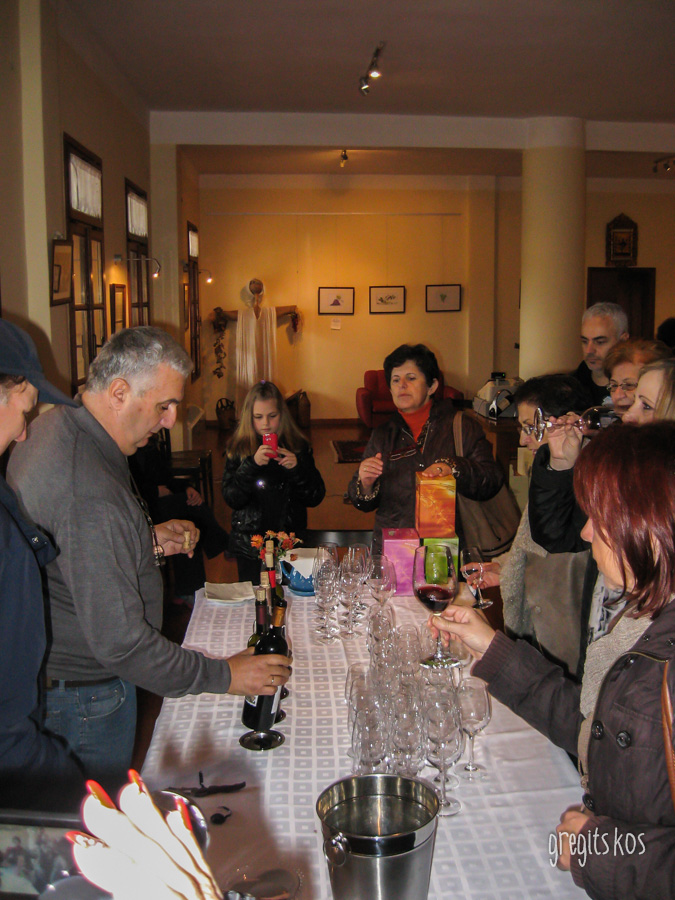
 fountain in its Center, built by the French soldiers and reminiscent of the times of the first world warThe appointment with the winemaker Mr. Aidarini an hour later, boosts our mood. Being an excellent tour guide himself, he explains everything about the tradition of viticulture in the region, the process until the bottling and aging of wine and leads us to the cellar with the big oak barrels. He treats us local wine in the beautiful building of the winery and informs us about the “roads of wine”: "In recent years, the old art of wine making, seems to have found its way. Thus, the known “xinomavro” wine, but also a local variety known as "Negoska" in proportion four to one, give the famous wine VQPRD "Goumenissa". The vineyards of Goumenissa falls on "Wine Routes", a civil company, non-profit organization created by the Wine Producers Association of the Vineyards of Macedonia. The integrated in the network wineries of the region are mostly in Goumenissa: "Domaine Aidarini", tel. 23430-42939, "Boutari Winery", tel. 23430-41989, "Tatsis Estate", tel. 23430-41053, 'Hatzivariti winery "tel . 23430-41236 and "Domaine Ligas" just before Giannitsa, tel. 23820-24421, as well as "Domain Eutychides Titos" tel / fax 2310-273620 Goumenissa " .

The town, however, has another asset, as we said. It has kept alive through the years its own musical identity. Famous throughout Greece and abroad, by participating in various festivals in the world, its bands of brass instruments, with at least three hundred folk musicians are now widely known as "The Bronze of Goumenissa". The price is a bit overwhelming for anyone who wants to enjoy them live. At least 150 euro an hour. Maybe if you're in the mood after the wine / tsipouro the price will not seem high!

We were told that the Folk Museum is worth visiting. It has recently opened in the neighboring village of Europe, since the one of Goumenissa is underactive.

Domaine AidariniAt the exit road of the city towards “Grivas” village you pass by a traditional water mill owned by Giapatzi family. It was built in the late 18th century and is a typical folkloric element in the region. The watermill has been working from 1860 to 1970 for the production of flour, was rebuilt in 2008 and is open to visitors every Wednesday from 9 am to 2 pm and weekends from 10 am to 7 pm.

We continued to the monastery of St. Raphael taking the road to Grivas- Kastaneri. We drove up a narrow winding road up to the monastery. In fact, while the monastery, in a nice location, with great views of the valley, it is still half-built. We lit our candles, bought a few chestnuts an drove downhill to the tavern. Or maybe we should say the hotel that would host us for lunch. Few options for large groups like ours. Hotel "Parifew" in Griva, tel. 2343042615, 6973881961 (Stathis) with nice lamb on the spit as the company assured.

We heard good things about “Kastaneri”, a village at a higher altitude near by but unfortunately the road was difficult for the bus and we decided not to go. But we can share the information we have! It’s not long since they have ended with the harvesting of chestnuts. Moreover, they have been organizing for many years the festival "Chestnut, wine, cheese" in the region! So just 10 km. northwest of Goumenissa, at the slopes of Mount Paiko, Kastaneri, is a picturesque mountain village renowned for its chestnuts and its wonderful views across Amphaxitis and the plain of Thessaloniki. The village is built at an altitude of 750-800 meters. Its inhabitants are locals Macedonians and has a cultural club named "Paiko" The inhabitants of the village, and especially the Dogiama family, played a big role in the Macedonian Struggle, fighting the Bulgarians in the town of Goumenissa, which then acted in the region.tasting wines As a token of gratitude, the Goumenissa residents gave the name of George (Gonou) Dogiama the old camp of Goumenissa. Most residents leave the village during the winter, while in summer it serves as a resort.

Also on the way to the village Karpi, at a short distance from Goumenissa, you will find the physical location "Two Rivers", with running flowing waters and a dense forest.
Authentic villages, dense forests of chestnut, beech and oak trees, green meadows, emerald ponds and wonderful waterfalls await to be discovered by car or on foot in the untrodden mountain tracks. That we will return to certify in spring.
Information gathered for the region
traditional house(Source: http://www.tanea.gr) Leaving the village Kastaneri, towards the “Megala Livadia” after 5 km. distance you come to the Environmental Information Centre of Paiko (visits by prior arrangement with the Forestry Cervice of Goumenissas tel. 41 207 23430). Just 1.3 km. below, in Primatari point, you will find a wooden observatory with spectacular views of the gorge. At this point, a beautiful hiking trail next to the stream of Stravopotamou starts. Soon the landscape is transformed. The dense forests give way to a bare plateau surrounded by smooth tops. Here, on the highest plateau of Paiko at 1,200 m. , the “Megala Livadia ”lay before you, which although is a Vlach village it is not famous for its dairy products, rather than for the exceptional quality of the potatoes. The village was built in 1769, by Vlach-speaking Greeks from Moschopolis, after the destruction of their city. The settlement grew into one of the largest in Central Macedonia in the early 20th century and was one of the bastions of Hellenism in the Macedonian Struggle, until torched and completely destroyed in 1944 by the Germans. Starting from “Megala Livadia” and heading towards “Archangelos”, get ready to enjoy one of the best asphalt tracks in the area. Just 700 m. far from the village, you will be facing a beautiful sight: on the right of the road, surrounded by wooded hillsides and potato fields, a small lake emerges, while in front of you stands the impressive mountain of “Tzena”. You can leave your car in the small space provided adjacent the asphalt, to admire the landscape and then continue among the green fields, the gentle slopes and rugged peaks of the neighboring mountains.

Aidarini winery

TIPS
What to eat?

In “Goumenissa” : tavern "To tzaki" on “Ethnikis Antistaseos” street, Tel .: 23430/41020 Open: All year round, daily, lunch and dinner (weekdays noon :call first), tavern “George” at the square .
In the village “Kastaneri”: "Argalios" (very good tavern)and "Platia" (tel. 2343023946/6946058280 Giannis Maris)) with local specialties: fried pork, local sausage, pork etc. (During the chestnuts harvesting the tavern is closed). The hotel's restaurant "Moschopolis" at “Megala Livadia”. For coffee, drinks and “tsipouromezedes” go to the "Casa di lemnou."
Shopping: In the village “Griva” there is a cottage industry "The Goumenissa" where you can buy jam, frumenty, noodles, and mountain herbs, tel. 23430-43455. Goumenissa - Kastaneri 12 km. (Asphalt)
The combination of landscape, wine, Macedonian cuisine and hospitality make Goumenissa a rising destination for alternative, naturalist getaways. We will, however, return here to enjoy the nuances of deciduous trees of Paiko in autumn and spring and also walk in the lush mountain forests.

Brass bands of Goumenissa: TEL. CONTACT 6979450334 & 6974986553    Asartzis Sakis 6976678255 (cornet)

the entrance of Aidarini winery

“Bridging the gap”. A weekend in the villages of Grevena

“Bridging the gap”. A weekend in the villages of Grevena

The tour began immediately after our arrival at the hotel "Pindos Palace", on the slope over the village "Lavda" and only a few kilometers far from the ski center of "Vasilitsa".

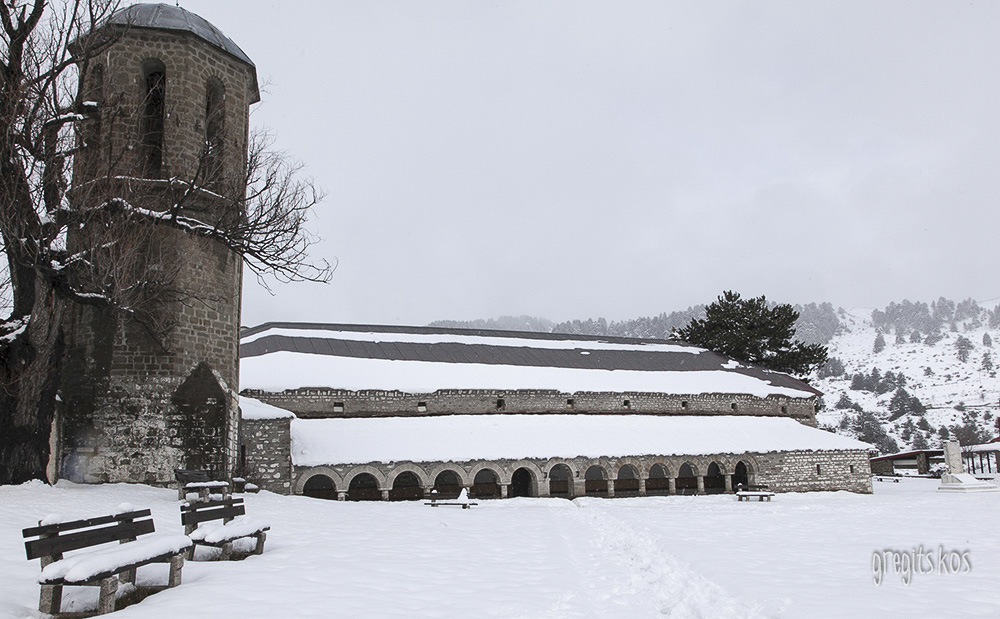
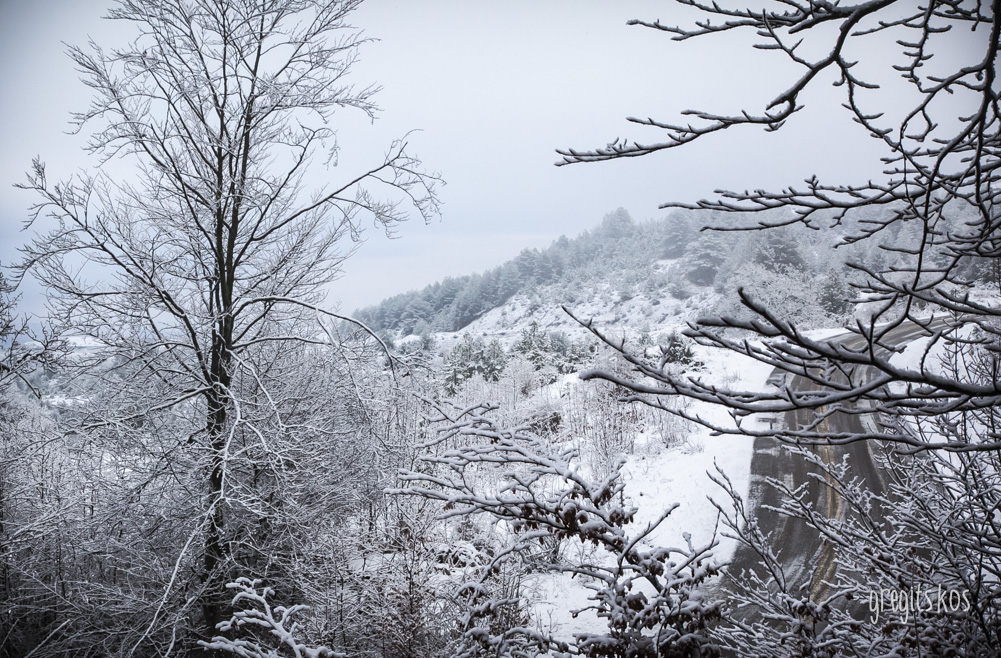
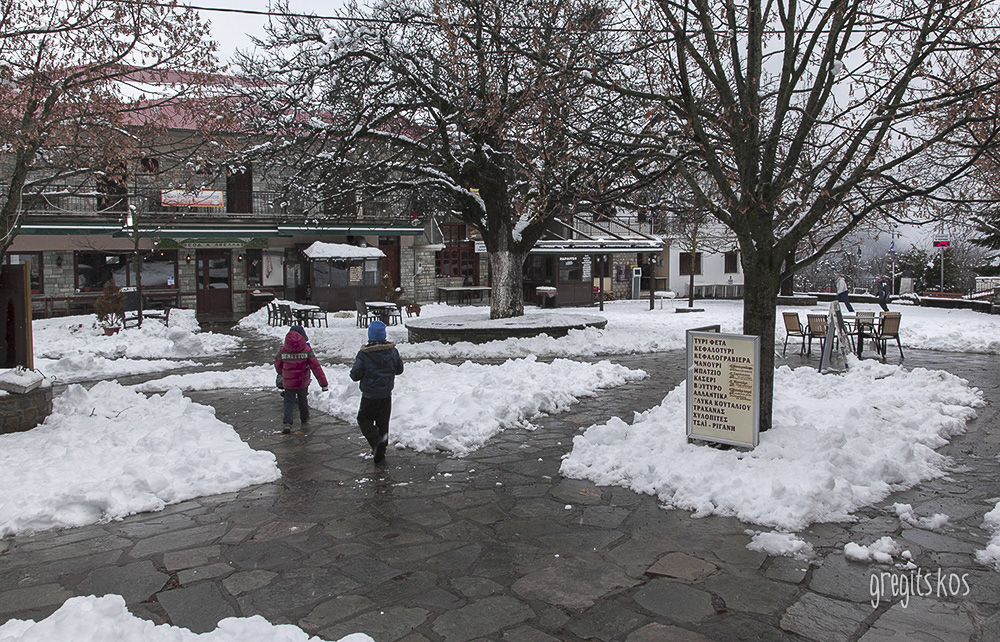
      Setting off from Veria at 9.30 we arrived at "Pindos Palace" hotel after a 2 hours' drive including a stopover for stretching our legs a bit in "Grevena". After checking in at the hotel and a delicious coffee we had, enjoying a wonderful view of the pine-covered slopes of the mountain, which at that time were covered with fresh powdery snow, we set off for our walk in the area. We have come here many times and in different seasons but each time the images are different. We marched in the snow, on a hill opposite the hotel and visited the small chapel standing at its highest point. The view was unique. We got in our cars and took the road to "Smixi", "Vasilitsa" and finally "Samarina". A pleasant journey that lasted about 40 minutes, as the snow that was falling was delaying us. But who was in a hurry anyway? In "Samarina" the snow had reached the 30 points in height, and it was untrodden in many streets and yards, as in the great courtyard of the Church of the Assumption (Megali Panagia). Taverns in the village square and two shops with traditional products gather all the human activity in the village. There are a few residents in the village in winter. The streets are deserted.the Church of the Assumption (Megali Panagia)

    The local grilled meat dishes and the famous mushrooms as well as the dairy products are a trademark of the area. We tried several of them and really enjoyed them! In the evening we decided to go to "Spileo" and have dinner in the tavern named "Partridge". It's better to visit "Spileo" during daytime. Following the narrow road, almost carved into the rock, on which the village is built, in a location of unparalleled beauty that cannot be easily described in words. The view seams endless! In the east you can see "Kamvounia", "Pieria Mountains", "Olympus" and "Ziygos" and in the west the "National Park of Pindos" with the beautiful valley of "Valia Calda". That's the reason they named it "the balcony of Pindos". We were "compensated" by the delights of "Partridge", since the rain that was falling incessantly would not allow us to walk around the village even in daytime. The attractions in "Spileo" are many with"Portitsa gorge" and the homonymous stone bridge being on top of the list. However, the road is and would be impassable with the rain falling or even after it. The dirt road would be too muddy!  On our way back to the hotel, in the dark mountain road we played a game: "Who will see the most hares"  jumping from the roadsides with their eyes shining in the lights of the car. The fireplace was lit in the hotel lounge when we returned.

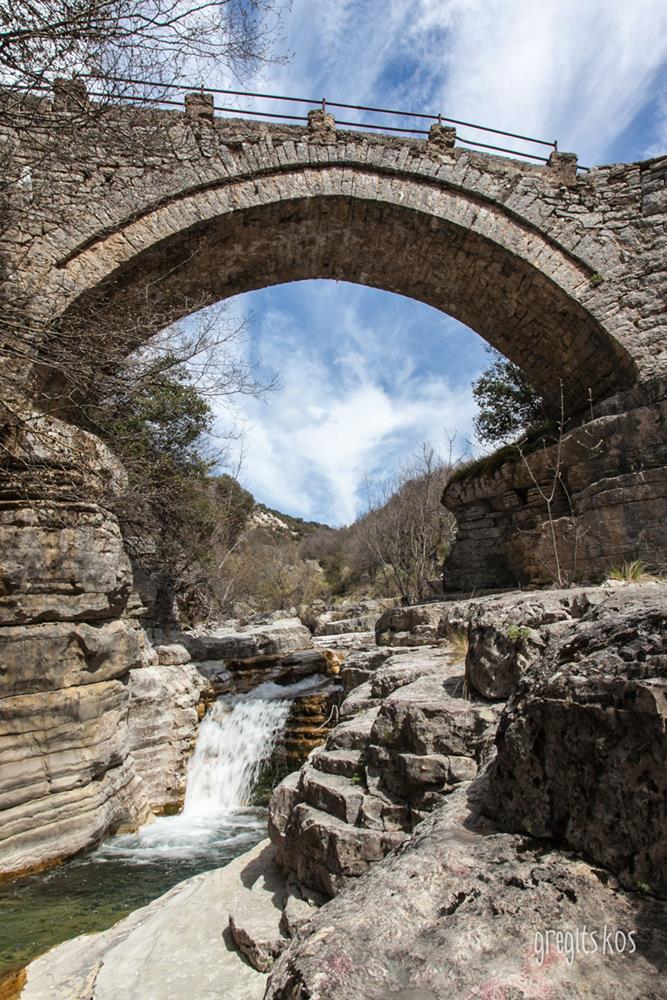
the road to "Pindos Palace"    So was the next morning. Around it we planned our morning stroll. The weather was getting better, so we happily decided to visit two of the many stone bridges of the area. The bridge of "Ziakas" over "Venetiko River" is right next to the road and well maintained. But what we saw after "Trikomo" could never be forgotten! The impressive arched bridge of "Aziz Aga", which is the highest of Macedonia, with the colored cliffs standing at the side of it, changing the flow of the river and forcing it to make a major shift in its waters. You have to literary climb it if you want to go over it. I cannot think of anyone that doesn't want to be on the top, to feel how everything from up there looks, from the 15 meters height. The thought of having a trip just for to visit the bridges of Grevena comes to our minds. It will not be long before we make it true!

    Our tour to the landscapes of unique beauty in "Pindos" is a real experience: dense forests of conifers, firs, beeches, maples, elms, lindens, poplars, pines, oaks and bushes, but also taps with running water to quench the thirst of the passer-by- travelers. Among the villages of the region, "Samarina" is located at the foot of "Smolikas Mountain", "Smixi" at the slopes of "Vasilitsa" (where the ski center is), while "Perivoli" and mainly "Avdella" and Krania are gateways to the national park of "Valia Calda". These are the "Vlach villages" in the area and are all built at high altitude.

    On the contrary, at a lower altitude lay the so called "Koupatsochoria" of  Grevena In Grevena , "Koupatsochoria" are villages in the southwest of the city, particularly around the mountain "Orliakas" (which is 1433 m. high). The word is derived from the Turkish "Koupati", that means "oak". There are the villages "Ziakas", "Spileo", "Kosmati", "Trikomo", "Lavda","Polyneri",  "Panorama", "Perivolaki", "Alatopetra", "Monachiti", "Kipoureio", "Aetia", "Filippaioi" etc. The Koupatsaraioi were normally breeders or kyratzides (mule drivers).

Samarina square Pindos Palace

The "Vlachochoria"

  Perched on the slopes of Pindos, between crystal clear streams and rivers, dense forests of pine, fir, beech trees and bushes, in a truly wonderful landscape, are built the "Vlach villages", namely Samarina, Perivoli, Smixi, and the Avdella the Dogwood, which belong to the prefecture of Grevena.

  Each visitor can see and enjoy the natural beauty offered by beautiful forests where several species of animals and birds (bears, wolves, deer eagles) live, while on the mountain slopes there are endless pastures where herds of sheep and goats graze. Moreover, the visitor can visit the picturesque churches, the stone bridges, samples of the culture of the Vlachs in the region.

region map Perivoli: a charming village which is located about 45 km from Grevena at an altitude of 1350 meters, in a lush dense forest of beech trees, bushes and trees, in the Pindos National Park Valia-Kalda (warm valley in Vlach). In the square stands the statue of Rigas and the church of St. George with the wooden iconostasis of 1770 and icons of that era.

Avdella: Built on the back side of the ski resort of Vasilitsa, Avdella is built at an altitude of 1250 to 1370 m. It has a beautiful paved square shaded by huge plane trees. Here as well residents number about 100 people in winter and in summer during the feast of the Transfiguration rises as high as 800! At the highest point of the village is built modern outdoor theater with endless views! *The "La fitsiorlou di la Mundi" restaurant meaning ("Stalwart Mountain") is located on the square.

Smixi: Smixi is the village chosen as a residence by those that visitat the "Vasilitsa ski centre" . Vasilitsa is the second highest mountain of Law. Grevena 2,249 m. The name of the village came from the smiximo settlements tables and bingo. The same phenomenon here: the farmers are leaving during the winter and the village is inhabited only by the hotel owners, the restaurant owners, waiters and chambermaids, around 200 people. But in the summer the population reaches  1,000 residents! In the second square the former primary school building is maintained in good condition (stone building of 1933) and has already been converted into a hostel.

Samarina: It is the most famous village of the Vlachs at an altitude of 1450 m. in the square. However, some houses are located at 1530 m. It also holds the title of most mountain village not only in Greece but in the whole Balkans. The inhabitants are occupied with farming and logging wood. In winter (especially on weekdays) residents do not exceed 50, on Saturdays are usually over 200 in the summer reaches 700, culminating in a fortnight from 5 until August 20, so high as 2000! More specifically, a large festival is held here to celebrate the Assumption of the Virgin, on the yard surrounding the church of the Assumption. In the central square of the village the visitor will see the church of Virgin Mary (Megali Panagia). Built in 1819, with a characteristic pine that grew in the sanctuary of the church, which protrudes above the roof of the church, while the roots are not visible in the church.
For local cheese, as well as several other local products traditional products shop The House of Cheese you will find in the square in. Sale slice, Gruyere, Parmesan, galotyri, gruyere, cream cheese, cottage cheese, cheese, frumenty, noodles, liquor and sweets. Tel. 6946466101 and 6946466102.

Spileo (meaning "cave") Spileo is a settlement 25km west of the city of Grevena, in the mountains of northeastern Pindos. It belongs to the municipality Theod. Ziaka of N.Grevenon and today has 160 residents. It is built at an altitude of 980 m. on the southern plateau of Mount Orliakas Two rivers, Perivoliotikos from the west and Smixiotikos from the east are joined beneath a steep cliff but with great beauty and create "Venetikos",  the main tributary of Aliakmonas. The location of the village is exceptionally beautiful. The view is vast and you can see Kamvounia -Pieria-Olympus-Zygos in the east and the National Park of Pindos with the beautiful valley of "Valia Calda" in the west. That's why they call the village "the Balcony of Pindos" , Aetofolia (eagle's nest) etc. Because of its great location and long history, the village and the hole region are protected and have been classified by the Ministry of Culture in June 1973 as a Historian and of outstanding natural beauty place.
The sights of the village you will really enjoy have been created by the erosion of the limestone rocks, through the years, especially by the two rivers,  which created two rare and remarkable gorges. Firstly, the canyon of Portitsa, with the stone bridge at its mouth. Its height is 300 meters and its wild beauty fascinates you. The river that crosses it, is "Perivoliotikos". Secondly, "Liatisas " gorge, having the same beauty but it is hardly accessible. "Smixiotikos" river crosses this one. There are two stone bridges in the area as well, "Katsoyannou" and "Liatisas". Another attraction is "Vaenaki", a tunnel 10 meters long that permeates "Portitsa" rock. Of course, a visit to the Monastery of Virgin Mary is necessary, to admire some remarkable paintings and the architecture of the church. It would be ideal to reach "Portitsa" on foot going downhill on the dirt road. Hold your strength  for the return, though!

Portitsa gorge Grevena Town Clock

Ziaka bridge

Lavdas
    The Mushroom Museum in Lavda Grevena opened on 6 November 2011. In a traditional stone building a great collection of mushroom exhibits is hosted : natural wild mushrooms, dried ones, and sculptures, which were incorporated in showcases which are miniature of nature. Information is given for all mushrooms along with rich literature and audiovisual material.


BRIDGES

     In the prefecture of Grevena you can see 17 arched bridges: Portitsa Bridge, Kagelia bridge , Aziz Aga bridge, Stavropotamou bridge, Spanos bridge, Tourkogefyro, Katsoyannou bridge, Liatissas bridge, Stampeki bridge, Matsagkani bridge, Dotsiko bridge, Pasha bridge, Pramoritsas bridge, Paliomagero bridge, Papataki bridge, Prosvorou bridge and Castle bridge. The stone bridges of Grevena will travel you from the eastern slopes of Pindos until Vasilitsa and the southern slopes of Voio and will help you pass Venetiko river, Velonia river and the dozens of streams and tributary of Venetiko and Aliakmonas.

Aziz Aga bridge

 For those that want more information on the bridges
You can find information in the following link :http://www.grevena.gov.gr/
Or ask us for a detailed map and directions